Performance Capacity Assessment
Physician-Led Performance Diagnostics
Your Next PR Starts With Better Data.
You are already training hard. The question is whether your physiology is allowing that work to produce the result it should. This physician-led evaluation identifies the primary physiologic restraint limiting your speed, strength, endurance, recovery, or repeatability, and gives you a clear strategy to remove it.
Call to Book: (480) 418-7193For serious athletes training toward a race, competition, event, or measurable performance goal.
*Packages starting at $1500*
You May Not Need More Training.
You can be disciplined, well-coached, and still underperform. More volume is not always the answer. Neither is another supplement, recovery device, diet change, or generic hormone panel.
Your limiting factor may be:
- Inadequate oxygen delivery
- Poor aerobic efficiency
- Early carbohydrate dependence
- Autonomic or neuroendocrine strain
- Inadequate recovery and tissue regeneration
- Endocrine dysfunction
- Nutrient deficiencies
- Inflammation or impaired metabolic regulation
Most medical evaluations look for disease. Most performance evaluations look at workouts. We evaluate the physiology connecting the two.
Find the Restraint. Build the Plan.
Steadfast practices Capacity-Based Medicine: a system for determining which part of your physiology is currently restricting your ability to produce, sustain, and recover from high output. Rather than treating every abnormal marker equally, we identify the system creating the greatest constraint on performance.
The Five Capacity Domains
Oxidative and Mitochondrial Capacity
How effectively you produce aerobic energy, sustain output, and resist fatigue.
Neuroendocrine and Autonomic Regulation
How well your nervous system and hormonal systems respond to training stress and return to baseline.
Cardiopulmonary Delivery
How effectively your heart, lungs, circulation, and blood deliver oxygen to working tissue.
Fuel Regulation and Metabolic Flexibility
How efficiently you access and use carbohydrates and fats across changing intensities.
Inflammatory and Regenerative Capacity
How effectively you repair tissue, manage training stress, and remain healthy enough to train consistently.
Your assessment determines which restraint is primary, which factors are contributing, and which interventions deserve your attention first.
What the Assessment Includes
Physician-Led Medical and Performance Evaluation
A detailed evaluation of your training demands, performance history, recovery and autonomic patterns, fueling strategy, injury and medical history, current interventions, symptoms, and upcoming goals, performed through the lens of what your body must do to compete.
Performance Test Day
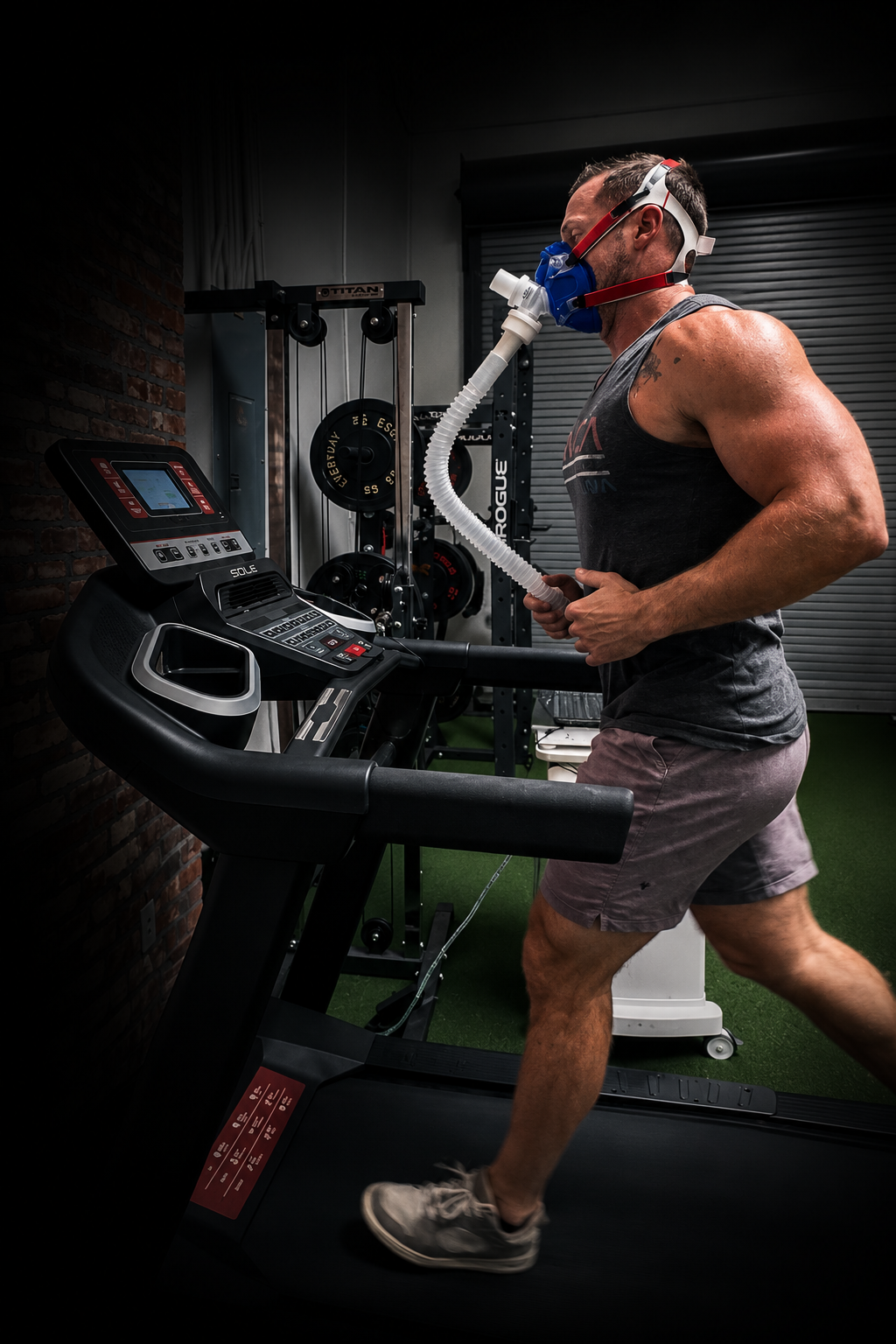
Comprehensive laboratory analysis paired with resting metabolic rate testing and VO2max metabolic exercise testing, examining thresholds, fat oxidation, oxygen pulse, ventilatory efficiency, heart-rate recovery, and sustainable training zones. Together, roughly 150 actionable data points.
Performance Strategy Consultation
We connect your history, labs, metabolic testing, and competition demands into one coherent performance model, so you leave knowing what is limiting you, why, what needs to change, and what to measure next.
The value is not the number of markers collected. It is knowing which ones matter for your performance.
Within the SCI Framework
Testing is not the endpoint.
A VO2 test can tell us how much oxygen someone consumes. It cannot, by itself, tell us why performance is limited.
The Performance Capacity Assessment integrates exercise physiology with the broader SCI framework so performance findings can be evaluated alongside fuel regulation, recovery, cardiovascular delivery, hormonal environment, inflammatory load, and Capacity Expression.
The objective is not simply to produce a better testing report. It is to identify the physiology most likely to unlock the next meaningful improvement.
Not Another Generic Optimization Plan.
You will not receive a long list of every imperfect marker followed by 20 equally important recommendations. You will receive a hierarchy. The goal is not to optimize everything at once; it is to remove the bottleneck that is preventing your current work from producing a better result.
- 1The primary restraint
- 2The major contributing factors
- 3The highest-leverage interventions
- 4The metrics that demonstrate the restraint is improving
- 5The implications for your training and competition preparation

Built by a Physician Who Understands Training.
Most physicians understand laboratory values but have limited experience translating them into athletic programming. Most coaches understand programming but cannot medically evaluate the physiology underlying a performance problem. Dr. Sean McGovern has spent his career on both sides of that divide.
Before developing Steadfast's Capacity-Based Medicine model, he spent nearly 20 years in strength and conditioning, including work with high-level competitive functional-fitness athletes. For nearly 12 years he has also evaluated athlete laboratory data longitudinally, tracking how physiology changes across training phases.
Your results are evaluated by a physician who understands training density, competition demands, accumulated fatigue, adaptation, and the difference between being medically “normal” and physiologically prepared to perform.
Who This Is For
Designed for athletes who:
- Train consistently but have stopped progressing
- Fade earlier than expected during races or competition
- Struggle to repeat high-output efforts
- Recover poorly despite disciplined habits
- Have strong peak performance but an inadequate aerobic foundation
- Have endurance but lack power, strength, or late-stage output
- Suspect hormones, fueling, sleep, inflammation, or recovery are limiting progress
- Receive “normal” laboratory results but know something is still not adding up
- Want objective data their coach can actually use
- Have an upcoming event and do not want to waste another training block guessing
You do not need to be a professional athlete. You do need to be serious about understanding and improving your performance.
What This Is Not
- A basic annual physical
- A standalone VO2max test
- A generic hormone panel
- A supplement sales consultation
- A prewritten nutrition plan
- A replacement for your sport coach
- A promise that every performance problem has a medical solution
This is a focused medical and performance assessment intended to determine what is actually limiting you and what the evidence supports doing next.
Frequently Asked Questions
- Do I need to have symptoms?
- No. Many athletes do not feel clinically unwell. Their concern is that performance, adaptation, or recovery is not matching the quality of their training.
- What happens when my standard laboratory results are normal?
- Standard reference ranges are primarily designed to identify disease, not explain athletic output. We evaluate patterns across your history, laboratory findings, metabolic testing, training demands, and performance trajectory.
- Is this an ongoing coaching program?
- No. This is a focused assessment and strategy process. You can implement the roadmap independently or provide it to your existing coach.
- Can my coach participate?
- Yes. Your coach can be incorporated into the strategy process so the findings can be translated into training decisions without creating conflicting plans.
- Does the assessment include prescriptions or ongoing medical management?
- The assessment includes the medical evaluation, testing, interpretation, and strategy roadmap. Any ongoing treatment, prescriptions, or follow-up medical management will be discussed separately when clinically appropriate.
- What about drug-tested athletes?
- Recommendations can be developed around the rules of your sport. Any medication, hormone, peptide, supplement, or nutraceutical recommendation must be evaluated against the current rules of your governing organization and applicable therapeutic-use requirements.
Stop Guessing What to Add. Find What Is Holding You Back.
You have limited training blocks, limited recovery capacity, and a finite number of opportunities to perform at your best. Make the next one more precise.
Call to Book: (480) 418-7193Physician evaluation + laboratory testing + RMR and VO2max assessment + integrated performance strategy
Call to Book Your Assessment.
Speak with our team about suitability, scheduling, and next steps. We will help you determine whether the Performance Capacity Assessment is the right fit for your goals.
Call to Book: (480) 418-7193Prefer to send details first? Use our contact form and select Performance Capacity Assessment.